


Dr. Sarah Cooke spent twelve years as an NHS doctor before her own Crohn’s diagnosis changed everything. She retrained as a nutritionist, then specialized in binge eating and emotional eating. Now she works exclusively with women untangling their relationship with food.
In this episode we get precise about binge eating versus overeating versus just plain normal eating. We talk about the “no off switch” feeling almost every woman describes at some point. And we get into the emerging research on using GLP-1 medications for binge eating itself, not weight loss.
Episode Highlights & Timeline
- [1:06] Sarah’s origin story, from NHS doctor to Crohn’s diagnosis to disordered eating specialist
- [11:19] Binge eating vs overeating, and what the DSM criteria leaves out
- [22:42] What food noise actually is, and why there’s almost no research on it
- [24:34] Sarah’s take on using GLP-1 for food noise and mental chatter
- [26:08] The emerging research on GLP-1 for binge eating specifically
- [35:10] The “no off switch” feeling, and where it actually comes from
- [42:00] Why occasional emotional eating isn’t something to feel ashamed of
Mentioned in the show:
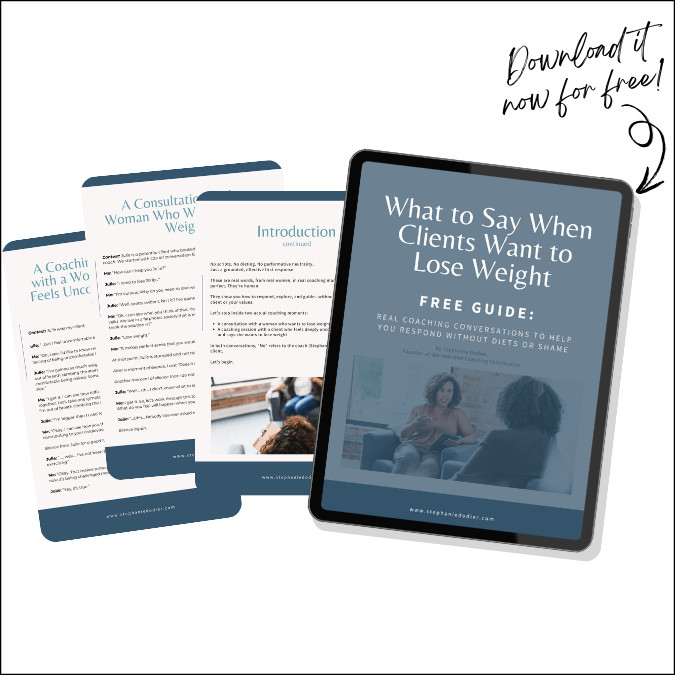
Dr. Sarah Cooke’s Free 7-Step Guide
Beyond GLP-1 Expert Podcast Series
Non-Diet Client Assessment Tool
Non-Diet Coaching Certification
Full Episode Transcript
This transcript was auto-generated and lightly edited for clarity.
Click to expand the full transcript
What’s the difference between binge eating and overeating?
Binge eating and overeating are not the same experience, even though they get used interchangeably. Overeating, like having a second plate at a family dinner, usually happens in a regulated nervous system. You’re aware of what you’re doing, you might feel emotionally present, and afterward you might feel uncomfortably full but not ashamed.
Binge eating is different. Clinically, binge eating disorder involves eating a large amount of food in a short period, three or more times a week for at least a month, followed by significant guilt or distress. But the DSM criteria only tell part of the story. What separates a binge from overeating is usually the nervous system state underneath it, a feeling of being out of control, zoning out, or dissociating during the eating itself, followed by shame rather than simple fullness.
According to Dr. Sarah Cooke, a former NHS doctor and binge eating specialist, almost every case of binge eating traces back to restriction somewhere, and it is not always the obvious kind. Mental restriction, like a running calorie count, guilt around certain foods, or simply not eating enough for your body’s needs, can trigger the same brain response as active dieting. The brain interprets that restriction as scarcity and responds by making eating feel urgent and difficult to stop.
The practical takeaway is that recognizing the difference matters less than understanding the pattern underneath it. Someone who occasionally overeats at a celebration is not the same as someone who binges in secret out of shame and urgency. But both patterns are worth paying attention to if food, guilt, or body image are taking up a disproportionate amount of daily mental space.
Transcript
[00:00:03] Stephanie: Welcome to the podcast, Sarah
[00:00:05] Sarah: Thank you. Thanks, Stephanie.
[00:00:07] Stephanie: I’m very excited to have you here. We met on Instagram, I think a couple months ago? Yeah. And we’ve been following each other since then. So I wanna introduce you to my listeners. So Sarah is a former NHS general medicine doctor, registered nutritionist, and now specializing in disordered eating.
[00:00:28] Stephanie: Mm-hmm. So I’m gonna hit you with the first question, is your origin story. How does an NHS doctor… For those who don’t know, NHS is the, um, I guess we’ll call it the associat- the medicine of England, the public service health of England. Yeah Is that it?
[00:00:44] Sarah: The Nat- National Healthcare Service. National Health Service, yeah.
[00:00:48] Stephanie: Yeah. Yeah. Uh, very similar to Canada, where we have public health. May be very different for American, who are all private care. But you were a doctor, and now you’re [00:01:00] working- Mm-hmm … with disordered eating. So I wanna know the origin story of that transition. I’m very curious. Yes.
[00:01:06] Sarah: Yeah, sure. So, um, yeah, I was a, I guess a family medicine, uh, doctor.
[00:01:10] Sarah: Um, and I… So I’d, I’d been a doctor for about 12 years. Um, and during that time I got diagnosed with Crohn’s disease, so inflammatory bowel disease, um, around, uh, well, it was about 11, 12 years ago now. Um, and so in that, during that time, I had to have surgery. It was all a little, it was all completely out of the blue really, and there’s a lot changed, uh, for me and my health at that point.
[00:01:38] Sarah: Um, and I, I started be- to become interested in nutrition and how it can affect the gut. And I, I remember the consultant saying like, “Nothing really needs to change. We’ll put you on medication. You don’t need to worry about your diet, just…” There was, there was no advice given to me about it. And I, I think at the time, in, in hindsight, I was [00:02:00] searching for some control over this disease.
[00:02:03] Sarah: So I got more interested in nutrition and decided to train alongside whilst I was working as a nutritionist, um, with a, with a view possibly to specializing in kind of, uh, inflammatory bowel disease nutrition or just understanding how much food can impact our bodies. Now, um, I think i- on, on reflection, again, lots of reflection around this, um, I was very much still in kind of diet culture when I went to study nutrition.
[00:02:34] Sarah: And the NHS, as I’m sure a lot of healthcare systems are, are very kind of weight-centric and, uh, I kind of very much had kind of good and bad foods in my head, you know, a, like, a perfect, quote, unquote, air quotes, way of eating. You know, I, I felt that the, the… for me, in a way, I guess I was trying to make my diet as perfect as possible to prevent a disease coming back.
[00:02:58] Sarah: So I [00:03:00] kind of explored this more. I qualified as a nutritionist, carried on working in the job that I was doing. I had my first child. I kind of burnt out in, in medicine a bit. Um, realized that there was quite a lot of perfectionism from me
[00:03:15] Sarah: with, with the work, but also some people-pleasing and other traits that I now learnt a lot more about, obviously, doing the work that I do. But I had the intention that I was gonna switch careers, so I was gonna be- become a nutritionist full time and- help people from, so from, I’m tr- and I’m trying to remember specifically what it was, but essentially I moved away from Crohn’s disease and into actually, uh, weight loss.
[00:03:41] Sarah: So I, I thought- Oh … right, I’m gonna, I’ll help people, uh, with their diets, um, help them lose weight. And I think with the background that I was in from medicine and, you know, so many of our guidelines for a lot of diseases were recommend weight loss, recommend weight loss. So it was kind of a little bit, you know, entrenched in my brain that, oh yeah, we do that, that’s the [00:04:00] solution.
[00:04:00] Sarah: So I started my… I think I worked for free for a bit just to get some clients up, or a very, like very low cost. And I would give them recommendations and I could, I could f- I started to feel really conflicted because I was, like becoming a bit aware of diet culture. It was becoming a little bit more prominent in social media.
[00:04:18] Sarah: And I would be giving these clients advice. It was a very much like I’m the expert, I tell you what to do kind of dynamic, and not that I probably was conscious of that, but, you know, again, in hindsight. Yeah. Um, and I, I really felt, yeah, a lot of confliction around, if that’s a word, conflicted around that, you know, we were demonizing foods.
[00:04:42] Sarah: We were being like, “Yeah, okay, you can have that, but as long as it’s, you know, as long as it’s a small amount, as long as it’s in moderation.” But, you know, there was these kind of pr- these, uh, restrictions that were there that just made me feel quite uneasy, and also really made me assess what, how I was eating and my [00:05:00] relationship with food as well.
[00:05:01] Sarah: And, and then when I carried on, I carried on for a bit and I would notice this pattern of people going, “Yeah, I, I’m doing, I’m having the meals like you’re talking about,” or like, “I’m building my plate this way, but I’m still binging at night,” or, “I’m still, food is still my coping mechanism.” And this was like really in most of the clients that I was working with, this was happening.
[00:05:25] Sarah: And I just felt really stuck. I felt like I need to up-skill in how I’m managing this, and it just kind of confirmed for me. I was like, I don’t like the direction that this is going in for me. So I, um, went online and I kind of looked for courses, like how do I up-skill in this? Because it was not something that it was widely available.
[00:05:48] Sarah: Like, we don’t… I think we talk about it a lot more now, but it’s still quite, um, un- like below the radar, I would say, in, in kind of the, the general world. Um, [00:06:00] so but I, I did some training. I did some further training with a, um, Irish… She’s an Irish psychotherapist at a company, um, called Eat Freely, and that was particularly specializing in disordered eating and binge-eating.
[00:06:13] Sarah: So I did that diploma, which absolutely just opened my eyes to this whole world of in- It, it wasn’t an intuitive eating course, so it’s not… I don’t call myself an intuitive eating, uh, nutritionist, but it has principles- Yeah … that are kind of, you know, overlapping there. But it absolutely opened my eyes to all the other work that needs to happen for someone to feel okay with food, to feel okay in their body.
[00:06:41] Sarah: And, and since then I just was like, this is it. This is, this is where I wanna be. I, I think it’s important to say that as a teenager in my 20s, I definitely had restrictive eating. I would probably say it was definitely an eating disorder. Um, so I d- I, I really… There was something in me that really, um, yeah, really [00:07:00] related to a lot of the stuff that was coming out when I was studying and, and training for this.
[00:07:03] Sarah: So that was two and a half years ago now And I’ve been doing the work, uh, since then, yeah, with clients.
[00:07:08] Stephanie: Yeah. It’s fascinating ’cause I’ve been doing hundreds of interview with practitioner, and I don’t think I’ve ever met someone who doesn’t have a lived experience. Like, it’s- Yeah … like the, the only way for us to really see true what we were taught in school, just like you, I was taught weight-centric, meal plan, tell people what to eat.
[00:07:29] Stephanie: Yeah. I’m the expert, you’re, like, lower than me, was very, like, a system- Yes … of, like, I’m better than you, so you better listen to me. That’s what we’re taught in school. Mm. And then we start working with people and, and we see our pattern. I know for me, that’s what it was. Mm-hmm. I saw my pattern reflecting in my client.
[00:07:51] Stephanie: I’m like, “Holy sh- shit.” Like- Right? Yeah, yeah. Not only am I not alone, because up to then, it was very secretive as a [00:08:00] person- Mm-hmm … because I was in school with other professional, I couldn’t talk about my stuff. Mm-hmm. And then I’m starting to see these human being replicating the same thing as me, like, I’m not alone, and I’m causing harm.
[00:08:11] Stephanie: Mm. Like-
[00:08:11] Sarah: Yeah …
[00:08:11] Stephanie: what? I don’t know if you felt- Yeah … the same way, but-
[00:08:14] Sarah: Yeah. Yeah. And, and it was that, like, the, the harm thing, but also, yeah, the, the real, like, oof, this is … It, it … I, I definitely wouldn’t say I necessarily felt triggered by what they were saying, but it was like, “Ooh, this is bringing up something here.”
[00:08:27] Sarah: Yeah. Like, I- I’m feeling like I really wanna help you because I know exactly how you’re feeling. Mm-hmm. But I don’t know where to begin. And that kind of scared me a little. Scared me into action. Yeah. So that’s, you know, good thing. But um, yeah, absolutely. I think the lived experience is probably something, as you say, that’s really common-
[00:08:47] Stephanie: Yeah
[00:08:47] Sarah: amongst people that work in this area.
[00:08:50] Stephanie: Because everywhere we go, like you talk about the NHS, um, in Canada, we are a little bit more forward in our thinking, where we are heading [00:09:00] towards weight neutral health.
[00:09:01] Stephanie: Mm.
[00:09:01] Stephanie: Uh, but most medical system around the world are very weight-centric. So- Mm-hmm … we come out with those diploma, but we have no clue how to not help people without weight loss and without- Yeah
[00:09:13] Stephanie: restrictive eating. We have to go and seek more training because believe it or not, for the listener, we’re never taught any of this in school.
[00:09:21] Sarah: No, absolutely not. I had to really dig. Like,
[00:09:27] Sarah: I was like, “Where do I get this?” Because this is not, this is not common knowledge for me and- or any, let alone as both a doctor or a nutritionist. I was not taught any of it. Yeah. Which is crazy, really.
[00:09:35] Stephanie: Especially as a nutritionist, right? Mm-hmm. That we’re not taught eating pattern, we’re not taught disordered eating, is just, like, mind-blowing.
[00:09:42] Stephanie: So I guess the message is for my listener, as you’re working with health professional and you- Uh, wanna be sure that they are n- they have some kinda training if, especially if you’re deciding, which my listener are, you wanna, in a weight neutral [00:10:00] aspect of health- Mm-hmm. Yeah … don’t assume that we receive that training in school, because we don’t.
[00:10:04] Stephanie: No. Like, we need to go outside.
[00:10:05] Sarah: Absolutely. Yeah, and, and j- sorry, just to add to that, Stephanie, ’cause I’m, I’m training to be a therapist as well.
[00:10:11] Stephanie: Yeah.
[00:10:11] Sarah: And certainly in U- the UK- With eating … like, there is no training in eating disorders in my curriculum. Like, you have to go and specialize afterwards. So question the therapist as well, like, what, what further training do you have?
[00:10:23] Stephanie: And I’ll add to this, I, I’m training therapists who have been trained in eating disorder, and I train them with body image. Mm-hmm. Because there is some eating disorder therapy training with no element of body image, which we know- Wow … that 83% of eating disturbances are caused by body image disturbance.
[00:10:44] Stephanie: Yeah.
[00:10:45] Stephanie: Yet we have no… It’s not part of the curriculum. Yeah. So I wanna focus our conversation on binge eating. Mm-hmm. Because I hear a lot on social media, when people are at the beginning of their [00:11:00] journey- Mm … people self-labeling as quote, “binge eater” or people who binge. Um, but yet when I, when I see them or when my students see them, they’re not binge eater, they’re just eating normally.
[00:11:17] Stephanie: So-
[00:11:18] Stephanie: Ah
[00:11:19] Stephanie: Let’s talk about what is binge-eating versus, I don’t know, overeating? Mm. Yeah. Like, how do you define the two, or how do you separate the two for the listener so they can perhaps try to identify their eating pattern?
[00:11:35] Sarah: Yeah. So there is the specific, like, DSM criteria that we can think about. So there is, um, which I still think brings in a bit of subjectivity, but it’s the eating a large volume of food.
[00:11:48] Sarah: Again, subjectively, what is that? But a large volume of food in a short amount of time, three or more times a week, I believe. I think it’s three episodes or more a week, um, which [00:12:00] needs to be going on, uh… It’s for not a huge amount of time, I think like a month that they’ve say to, to get the diagnosis. But it’s also followed by a lot of guilt after eating.
[00:12:10] Sarah: Mm. That’s kind of one of the characteristics. Now, um, I think the, the large volume of food is a lit- again, it’s that subjective, uh, thing there. So, um, that’s part of why it can feel hard to know if it’s binging or not. What I also bring in when I’m working with clients is, like, how you’re feeling when it’s happening.
[00:12:30] Sarah: So most people feel out of control. They don’t feel able to stop it. They feel like they’re zoning out. Often people feel like it’s like out-of-body experience or they’re, like, a bit of a mist coming down and it just, there is no stopping that bingeing when it’s, when it’s kind of about to happen or in, or in swing.
[00:12:48] Sarah: Versus just overeating at a meal where you’re maybe emotionally regulated versus possibly not being emotionally regulated. That’s, that’s the other thing that we wanna think about with binge [00:13:00] eating, is that, um, what’s your nervous system doing when you’re going into that type of eating as well. So you’ve got the kind of DSM, like, you know, medical criteria, but actually I, I think e- exploring it in terms of what feelings are happening for you when you’re eating is also really important.
[00:13:19] Sarah: Um, yeah. I- and I would also probably add that having a diagnosis of binge eating disorder doesn’t necessarily make any difference to accessing-
[00:13:30] Stephanie: Yeah …
[00:13:30] Sarah: help, you know? So, okay,
[00:13:32] Stephanie: so there’s a lot to unpack. Mm. So you s- you mentioned- Well, we’ll start with regulated nervous system. For the- Mm … beginner in this journey, what does that mean when I’m binge eating or eating a lot in a re- dysregulated state versus a regulated state?
[00:13:53] Sarah: Yeah. So it’s, a dysregulated state is going to [00:14:00] be, there’s gonna be urgency there. Mm. Because essentially your brain is going to take whatever emotions are happening and, and think, “This is unsafe. We need to, we need to change this.” And the food is providing a dopamine hit for that to happen, so it wants to be, you know, feel, feel, feel differently to how you’re currently eating.
[00:14:19] Sarah: So I would say the difference between a regulated state is that it is less urgent. Like, you, you might be overeating, you might be going, “Actually, I’ll just have one more serving of pudding,” or I’ll… But you’re sitting, you’re, you’re maybe noticing how it tastes. You’re, the urgency is less versus binge eating, which is usually because a lot of the, the decision-making is coming from your subconscious brain, like, it’s a very quick, very fast decision.
[00:14:47] Sarah: So y- you may be aware of emotions that are happening, but you also may not be. A lot of people come to me not at all in touch with emotions. So the emotions may not be something that you’re super aware of [00:15:00] if you’re s- just starting in your journey, but you might be aware of that feeling of, “Before I know it, I’m in the cupboard.
[00:15:06] Sarah: Before I know it, the packet’s gone.” And it’s like the- Yeah … speed and the urgency that, that that’s happening. That’s usually a kind of quite a, a good sign. Mm-hmm. The other thing I would add is that because recognizing that you’re binging, if you can do it earlier, you’re always gonna have more chance of interrupting it or changing the course.
[00:15:26] Sarah: So the other thing I talk through with clients is the thought patterns that are coming up. When you’re deciding to binge. So if there are these quite automatic thought patterns such as, “Ah, I may as well,” or, “Eff it,” or, “What the hell?” Yeah, all of those, that’s a little bit of an indicator, a little bit of a signal of like, ah, yeah, this is, this is falling into, um, getting relief from food or, or binging.
[00:15:54] Stephanie: Hmm. So for someone listening to this, I’ll give a, an example because I, I [00:16:00] was a binge eater prior to, um, doing this work personally, but… And tell me if that resonate with you. You’re sitting with the family dinner and you eat- you have a second, um, plate of food. You’re just talking with your family member and just Aunt Josie came back with her pie, and it’s just so bloody good, and you wanna have a second helping.
[00:16:21] Sarah: Hmm.
[00:16:21] Stephanie: That, and you feel full, right? You go sit on the couch- Mm-hmm … and you’re like, “Oh my God, I ate too much.” Mm-hmm. That’s overeating. Is that correct?
[00:16:29] Sarah: Yeah. I, I would say that. Now, overeating can still have some emotional components to it. Yeah. Obviously it can still have that, yeah. Yeah. But yeah, I would say that-
[00:16:37] Stephanie: I mean, we could, we could overeat for joy, because we’re with family we haven’t seen- Absolutely
[00:16:41] Stephanie: for a long time, right?
[00:16:43] Sarah: Absolutely,
[00:16:43] Stephanie: yeah. That’s what fe- By the way, I’m a fan of history, and if, for those of you who are a history geek, back in the days in medieval time, there was feasting happening. Yeah. Like, feasting, like, people were feasting, like you… Because they were joyful. Once a month, [00:17:00] once every two month, people were fif- feasting, and that was part of the culture.
[00:17:05] Sarah: Mm-hmm. Mm-hmm. Yeah.
[00:17:06] Stephanie: So. Interesting. Versus the binge eating, which is, and then perhaps you’ll connect with that, people… You’ll go do grocery and you buy a bag of chip when you’re alone, and then you eat it in the car before getting into home. Yeah. Binge-eating.
[00:17:21] Sarah: Yeah. It’s very secretive usually.
[00:17:23] Stephanie: Yeah.
[00:17:24] Sarah: Yeah. Yeah.
[00:17:26] Sarah: It’s because of, because of the shame that’s often associated with it, right.
[00:17:29] Stephanie: Shame and the speed, and you’re just like, you’re having food that is normally you can’t have, you don’t want people to see that you’re having.
[00:17:36] Sarah: Yeah.
[00:17:36] Stephanie: Uh, binge eating. So what is the difference between somebody who binge eat and somebody who has an eating disorder?
[00:17:46] Sarah: Um, s- well, I, I guess it, it really depends on what eating disorder we’re talking about. Obviously we’ve got-
[00:17:53] Stephanie: Yep …
[00:17:54] Sarah: things like Binge eating … anorexia. So, so, okay, so binge eating disorder versus binge eating.
[00:17:58] Stephanie: Yeah.
[00:17:59] Sarah: [00:18:00] Um, I think i- if we’re, if we’re purely looking at, like, the medical model, it would be- Yeah … about the frequency.
[00:18:04] Sarah: The frequency- Frequency … how many time it’s having, the impact it’s having on your life as well. Yes. So is it having a negative impact? Is it something that you’re aware that is really not helping you in your daily life? That, that would kind of come into h- it being a disorder. But the, the duration. So if you binge, I don’t know, once a year, no, you’re not gonna have the diagnosis of binge eating disorder.
[00:18:26] Sarah: Yeah. But if it is happening, yeah, every, every few days for, for months, a month or longer, then that’s, that’s kind of where
[00:18:35] Sarah: the diagnosis would, we would definitely think about. And that’s where
[00:18:41] Stephanie: it intersect also with the feeling of guilt and shame, because often when we talk about harm, we only think of physical harm. But I wanna broaden- Mm-hmm … the scope because it’s part of the weight neutral health approach, is when you see the body to be more than physical. Yeah. So we think about mental harm, emotional harm, [00:19:00] physical harm, and potentially spiritual harm as well.
[00:19:03] Stephanie: But it, the harm, the harm that you’re causing yourself with all these thoughts you were talking about, the guilt and the shame after, and the impact that that shame and that guilt has on your life. Am I correct?
[00:19:15] Sarah: Huge. Yeah, absolutely. Yeah. It’s all one, I think redefining healthy, and is part of this. So yeah, we’re not just talking about physical health here.
[00:19:24] Sarah: And, and whatever, what your thoughts are doing around your eating can have a huge impact on so- like every area of your life, I would argue. But your mental health can take such a hit when your relationship with food is, is this way. Absolutely.
[00:19:39] Stephanie: Yeah, because often people will think of binge eating, and not so much in this crowd, because people tend to listen to my podcast are a little bit more advanced in their journey.
[00:19:48] Stephanie: But in, in certain groups, people think, “I wanna stop binge eating because I’m gaining weight.” Mm. Right? That, that is a very dangerous territory. [00:20:00] You wanna talk about this? Mm-hmm. Yeah. Because I’m sure you meet some people in this way where their motivation is, “But I’m gaining weight, so it’s causing harm.”
[00:20:08] Sarah: Yeah, absolutely. I think pretty much everyone I speak to on discovery calls or even who starts out with me has a kind of, “Well, if I stop this, I’ll lose weight.” And it’s, and I’m always so clear about, like, the focus is not on weight loss for this work. But we … I think we are a, like the- It’s such a chicken and egg.
[00:20:32] Sarah: Like, as soon as weight loss becomes a focus, the binging is very likely gonna increase. And as you, I’m sure you talk about a lot, Stephanie, is that, you know, this is so much more than the food. Yeah. So the binging that’s happening, there will be so much restriction happening that the binge is always, I feel, feel like seen in isolation.
[00:20:51] Sarah: Like, if I could just stop the binging then, then it all will be good. And we’re, like, missing the huge piece that’s like, no, no, let’s, let’s look at the restriction. Let’s look at what’s driving it. [00:21:00] And again, if people have stopped dieting, so they may say, “Well, I’m not dieting right now, but I’m still binging,” I will nearly guarantee that there’ll be mental restriction around food happening.
[00:21:07] Stephanie: Yes.
[00:21:08] Sarah: Um, or mental restriction around joy and allowing themselves pleasure and all those other things. So when we talk about restriction, obviously it, it goes far more than just eating the food. But the I wanna stop binging because I wanna lose weight, or I’m gaining weight because of my binging, yeah, it’s, it’s such a, such a common kind of connection that people make.
[00:21:28] Sarah: And I, I do always say that actually people feel really … They can feel so panicked coming in, like everything feels out of control. And the- their belief is that if they lose weight then f- everything will feel calmer- Yeah … and things will feel okay. And so I talk about how actually often- It’s not the weight loss you want, it’s you wanna feel calmer around food.
[00:21:55] Sarah: And obviously- Yeah … we can, you know, in terms of body image, that’s a lot of exploration around weight loss anyway. But [00:22:00] when, when they’re coming to me, they feel so out of control around food that, that, their, their kind of the diet voice and the diet kind of way of thinking is like, “Well, I just need to lose weight then.”
[00:22:10] Sarah: And it’s like, no, that’s, that’s kind of the opposite really of what, what we need to be thinking around here. But it- it’s kind of almost that that’s how they, uh, vocalize it almost. Yeah. That that’s like how they’re, they’re able to kind of say what’s wrong, and we do unpick that a bit and go, “Well, I think it’s because you’re feeling out of control around food that you’re, you’re wanting to lose weight.
[00:22:28] Sarah: And if your food relationship felt a lot calmer and you weren’t binging, that desire for weight loss would potentially diminish.” Maybe not go away, you know. There’s of- often other work that needs to be done. But yeah, it’s kind of, um-
[00:22:42] Stephanie: Yeah. And that’s… A- and tell me what you think, but that’s, that’s food noise.
[00:22:46] Stephanie: That’s what I call- Mm … body noise. Like, you, we have this- Mm … we’re recording this in August of 2026, and the word food noise for the last 18 months has been all over the world, right?
[00:22:58] Stephanie: Yeah.
[00:22:58] Stephanie: Yeah. GLP-1 is [00:23:00] supposed to be like the thing that’s gonna solve it, but by the way, there’s v- there’s almost no research on food noise.
[00:23:06] Stephanie: So that’s the first thing. Mm. The second thing is w- what we know as food noise, just the thoughts you’re having, like you just described. “Well, maybe if I stop this, I’m gonna do this, and if I don’t…” Like, the mental chatter- Oh … is the food noise.
[00:23:21] Sarah: Mm-hmm. Yeah. Yeah. And it’s, it’s, it’s micromanaging every decision.
[00:23:25] Sarah: Every, every decision around food, around your body. I, I often label that diet voice as well, which can come into it. I don’t know if Stephanie- Same thing. Yeah … used that term, but you know, it, it absolutely kind of, um- But they’re almost one and the same, right? So it’s this constant like I should just do this, I should do this, I should…
[00:23:42] Sarah: Okay, well, I’ve had that so I need to make up for that or whatever it might be. But yeah, there’s this constant chatter.
[00:23:49] Stephanie: Yeah. That’s… But that’s what food noise is and that, I think, this is my presumption, that’s why they’re having a hard time with research because trust me, if GLP-1 manufacturer could have [00:24:00] demonstrated food noise, they would.
[00:24:02] Stephanie: Mm-hmm. Mm-hmm. But it’s just the normal mental chatter that happen in, in the human brain. Mm-hmm. It’s not a disease, it’s just the normal chatter, the conversation we have with ourselves, right? Mm-hmm. Yeah. On the day-to-day. On many topic, among of which food and body. And, and when you are in that type of relationship to food, the, the portion of the time you think about food is just greater than the average person.
[00:24:29] Sarah: Hmm. Mm-hmm.
[00:24:31] Stephanie: And overtakes your life.
[00:24:33] Sarah: Yeah.
[00:24:34] Stephanie: Um, so when we think about food noises, we think about the mental chatter, the guilt and the shame, what are your thoughts on GLP-1 and using GLP-1 for that kind of mental chatter and food noise? Mm.
[00:24:52] Sarah: Uh, yeah, I think it’s… I, I think if you’re, if you’re using a GLP-1 for food noise and that mental chatter, I [00:25:00] think that’s really problematic.
[00:25:01] Sarah: Yeah. Because it’s, it’s not addressing, you know, what, what, why it’s happening. And all it’s doing is… You know, it’s, it’s like taking the fire alarm off the wall and chucking it away, and yet that fire- Well, that’s a good- … is still
[00:25:16] Stephanie: burning … that’s a good analogy. Yeah.
[00:25:18] Sarah: You know, just because it’s not signaling, it doesn’t mean that there’s not a lot going on underneath it.
[00:25:23] Sarah: And if you have food noise, we know that food noise comes from restriction. So even like, as we say, even when people are eating enough and they’re like, “I’m not dieting,” there is gonna be mental restriction happening, or both. So unless that is addressed, like you’re, you’re signing yourself up to be on that GLP-1 forever.
[00:25:46] Sarah: And I don’t honestly… I, I, I’m struggling to-
[00:25:53] Sarah: understand how people are gonna do the work on food noise whilst they’re on a GLP-1 with the hope that when they come off [00:26:00] it, that work’s gonna immediately translate That’s, that’s my biggest concern when we’re talking about food, GLP-1s and food noise
[00:26:08] Stephanie: Or even binge-eating, because- Yeah … that’s, that’s…
[00:26:11] Stephanie: There’s one group that’s currently studying, obviously the group being the GLP-1 manufacturer, studying using GLP-1 for binge eating.
[00:26:22] Sarah: Mm. Mm-hmm.
[00:26:23] Stephanie: What are your thoughts on that as a binge eating expert? To me- Yeah …
[00:26:26] Sarah: that’s crazy,
[00:26:27] Stephanie: but I’m curious to see
[00:26:28] Sarah: yours. It’s… I, yeah, I feel there, there is some… Like, I felt really conflicted.
[00:26:32] Sarah: Like, I’ve, I’ve been a r- I’ve been… I’ve seen the journey with GLP-1s. I’ve seen, I’ve looked at evidence around, there are a few studies- Yeah … they’re not massive, and the evidence is mixed, and they’re short-term. They’re really sh- quite short studies. So, and, and I see it in practice, right? When people start lifting restriction and eating more, in general, their bingeing does decrease.
[00:26:52] Sarah: Now, that doesn’t necessarily mean that it’s gonna stay that way, because we know that there’s emotional components to binge eating as well, for a lot of people. For [00:27:00] some people it is- Yeah … they have been so restrictive, that actually it does, that’s it, they’re, they’re fine. But for most, there is more that needs to be done to change their, their binge eating habits.
[00:27:09] Sarah: And just because you are no longer hungry and you no longer have food noise, doesn’t mean that unless you’re doing the work specifically to work on that emotional regulation, and emotional processing, and looking at your life as a whole, where food is not the go-to joy or coping mechanism in your life, that, that’s gonna be very difficult to, to change.
[00:27:31] Sarah: But, but also even if you are doing that work on a GLP-1, I still, I think you haven’t… When you come off it, if you’re gonna come off it, and you haven’t done the work around food neutralization, and lifting restrictions, and tuning into your body’s hunger and fullness signals, and satisfaction signals, yes, you may have learnt how not to binge eat, and maybe tried to kind of train your, train that habit away, or, like, reprogram your brain a [00:28:00] bit.
[00:28:00] Sarah: Yeah. But then you’ve got all this other stuff to contend to, where food noise probably is gonna come back, and weight gain is potentially gonna creep in and… You know, so there’s… I, I think that it, it can be. I have had clients do the work with me whilst they’ve been on a GLP-1, um, but there is an acknowledgement that when they come off it, they, they may need to come back to me, right?
[00:28:22] Sarah: That, that, like, that… We’re, we’re kind of like, “Okay, you’re in a good place at the moment, but these medicines are extremely powerful, and we can’t predict how you’re gonna also be when you come off them in terms of, like, the emotion eating and binge eating.” Because there’s a lot more variables that are gonna come back into the picture when, when you’re off that medication.
[00:28:40] Stephanie: Yeah, because, uh, and, and part of it is the coun- your country of origin, right? NHS has, um, part of their public health, they’re, I don’t wanna say prescribing, but they’re paying, I guess. They’re giving the GLP-1- Yeah There’s, I don’t know if it’s a pilot test or if it’s like a- No, [00:29:00] I mean it’s- … standard practice, but- Yeah
[00:29:01] Stephanie: it’s a widely public health or public care strategy- Yeah …
[00:29:06] I
[00:29:06] Stephanie: guess, of prescribing GLP-1?
[00:29:09] Sarah: Yeah. There, there is, but it’s, it’s pretty, it’s pretty strict as to which people are gonna be- Ah … allowed it, right? So if you are… And initially, so it was a certain BMI criteria you had to fulfill. Yeah. And then you needed to also have particular conditions and medical conditions alongside that.
[00:29:27] Stephanie: Ah.
[00:29:28] Sarah: Um, for some people it is just done on BMI alone, but the majority of people that are gonna prescribed it, be prescribed it for life are the ones that have usually diabetes alongside or heart disease or a few other conditions. Um, so you’re pr- they’re pretty strict with who is gonna have it long-term.
[00:29:48] Sarah: Initially they were only gonna prescribe it for two years. I, I believe that that is- Yeah … changing because, like, um-
[00:29:55] Stephanie: Well, but that’s the point Like, they were treating it almost like a, a weight-loss medication where [00:30:00] you lose the weight- Yeah … then you don’t need it. So they’ve changed their tune on that?
[00:30:03] Sarah: Yeah. Yeah. Okay. They have. But, but you know, this is, this is a small proportion of people, right? So they’re, they’re, as, as we know, like, the, the vast majority… Well, that’s, that’s a bit of a sweeping generalization, but a lot of the people I see are getting it privately because they don’t meet- Yeah … the criteria on the NHS to get it, and then obviously you’ve got the funding- Ah
[00:30:22] Sarah: issues. Yes So yeah, cost-wise does still occur in the UK for a lot of people. Uh, the ones that are prescribed it on the NHS are very likely to stay on it in theory for life, but we know that may not also be the case because they can’t tolerate it. There can be many reasons why people come off it. But, um, yeah, that’s how it’s set
[00:30:41] Stephanie: up.
[00:30:41] Stephanie: But at least if you are in under the public care system and you meet the criteria for type 2 diabetes, you have it like metformin would be prescribed for life because it’s a medication- Yeah … for medical condition.
[00:30:55] Sarah: Yeah. Yeah, exactly, and I think that is- Yeah. So it’s a [00:31:00] different protocol and it’s a different- Yes
[00:31:01] Sarah: kind of, I, I, I would say, um, and it’s… Whereas I’m constantly seeing adverts for, in our- That’s what that’s- … country I’m sure is, you know, where it’s like, you know, you don’t… But you can be under BMI under 25 and still get the medication, and that’s great, and it’s like, oh gosh, well, we… You know, that’s, that’s the scary
[00:31:18] Stephanie: type.
[00:31:18] Stephanie: And, and that’s what I… So I made a prediction a couple weeks ago that we are heading straight as a s- Western society in a depth of a body image crisis because the majority of people using GLP-1 right now- Mm-hmm … are not under the medical, um, use. They’re not using it- Yeah … for type 2. They’re not using it for very specific condition.
[00:31:44] Stephanie: They’re using it for weight loss. Yeah. And that’s private care, that’s out-of-pocket expense. For most people, they will not be able to sustain that for the rest of their life, so we have a massive group of people- Yeah … in next year [00:32:00] or the years to come that will stop using GLP-1 and, as we know, will regain a majority of the weight, if not all the weight, and we’re heading back to a big body image crisis.
[00:32:11] Stephanie: That- Mm … that’s my opinion. We’ll see what happen in a year from now. Mm. Because people are not using it for medical condition. Mm.
[00:32:20] Sarah: Yeah. I, I, I, I heard you speak about this as I was listening to one of your podcasts, and I was like- Yeah … “Yeah, I feel that.” Like, and I’ve seen it. I’ve seen people use it, you know, be on it for a few months, lose a stone, lose, lose quite a significant amount of weight, and then come off it.
[00:32:32] Sarah: And, and I, I do think the people I speak to, there is this underlying like, “Yeah, I don’t wanna be on this forever.” Like, there is, there is some, some beliefs there which I’ve noticed that they’re kind of happy to use it in the short term, but they feel like, “And then I’m gonna come off it.” And then, you know, I guess they hope that they’ll just sustain the weight loss.
[00:32:53] Sarah: But it’s like this, “I don’t wanna be on it forever” type of feeling that I’m getting from, from the people [00:33:00] that I’m talking to, whether that’s connected to it- It’s
[00:33:02] Stephanie: very interesting because as a former 25-year dieter, that’s how I reentered every new diet. Mm. Right? The… So whatever. The low-fat diet didn’t work.
[00:33:13] Stephanie: I entered into the world of 1,200 calorie. And every time I remember vividly up to the last one, the keto diet, was like, “Okay, now this is gonna be different.” And it’s like putting my head in the sand saying like, “Don’t recognize the last 20 times you did this that didn’t work. I’m gonna be the, like the unicorn, the, like the-
[00:33:34] Stephanie: 5% of people.” Yes. “This is gonna work.” Yeah. Like, I’m gonna finally… And that’s what you’re describing. People, like, walk into this knowingly that they may regain the weight, but they’re wanting to be the unicorn- Yeah … where the weight’s not gonna come back.
[00:33:50] Sarah: Yeah. Totally. And, and we just know. We know that it just doesn’t happen.
[00:33:55] Sarah: In fact, you know, it comes back quicker than on regular dieting for a lot of people, doesn’t it? Yeah, that’s some… [00:34:00] what the evidence is kind of suggesting. So, um, I, yeah, the- The fallout from it when there is use that’s happening like this, I think is gonna be big. Yeah. Um, certainly from a body image perspective, but also what really from with my, like medical- Yeah
[00:34:18] Sarah: head on, I’m like, oh my goodness, like, if you’re getting access to it with a BMI under 25, i.e., you know-
[00:34:25] Stephanie: Oh …
[00:34:26] Sarah: normal, like the bone he- like the ramification, I’m not saying that the bone health won’t be affected for people who are in bigger bodies, but like we’re talking about becoming malnourished really.
[00:34:36] Sarah: Like this is the, the muscle loss but the bone, the bone kind of health, all of it, I just … That’s what I find quite scary for, you know, 10, 20, 30 years’ time when these people are entering
[00:34:48] Stephanie: old age. Yeah. And I, and I heard some of my colleague from a medical background having, not calling it the body image crisis, but calling it the health crisis to come because of that, and all the ramification of not [00:35:00] having a, a strong muscle mass and a strong bone health and all the issue that comes along with that.
[00:35:06] Sarah: Yeah. Yeah. Yeah.
[00:35:10] Stephanie: So I wanna talk about an expression that I saw on your Instagram, which I think will resonate with a lot of people. You said that a lot of people you work with when they first start working with you, they have no, quote, “off switch with food,” right? Which is like, like this out of body control experience with the food, and they are convinced that v- like it’s, they’re, the problem is them intrinsically, that they cannot- Yeah
[00:35:40] Stephanie: and there’s no way they can like have ever control with food.
[00:35:44] Sarah: Yeah. Yeah, absolutely. Yeah, the kind of no off switch. I hear that all the time. Um, and I, whenever someone says that to me I alw- I’m always thinking like, okay, there is restriction here, or there has been restriction at some [00:36:00] point. And- Whilst there may be…
[00:36:04] Sarah: And I think someone did comment going, “Well, this isn’t true for me because I’ve been binging since I was a child.” And what I would be thinking again even then is, like, okay, but were your parents, were they trying to limit? Was there comments there about what you were eating? Because if there has been scarcity around food, if your brain has experienced food restriction in some form, it’s gonna respond in a certain way, and it’s going to.
[00:36:26] Sarah: And especially if that restriction is still ongoing, as we talked about, not necessarily that you’re still dieting, but if you’re feeling guilty for having certain foods- Yeah … if you’re constantly, if that food noise is there, all of it. If you’re like, “Oh, I shouldn’t have this,” trying to limit portions, trying to be good, trying to be healthy, quote, unquote, “healthy,” you know, we all know what that means.
[00:36:43] Sarah: Um, then your brain is going to be absolutely wired to want to eat and eat and eat. And it’s gonna, it’s gonna… I always talk about this with people, like, your brain doesn’t trust you that you’re gonna feed it. So why, why is it… And, and it’s such a primitive [00:37:00] survival mechanism to need food and to- Yeah
[00:37:02] Sarah: that’s gonna protect us as a human race to survive. So that’s what it’s doing. It’s doing its job. So that feeling like you don’t have an off switch with food, there’s a reason for that. You were not born like that. It, it has come. You have acquired it. It is, your brain has learnt that from somewhere. And that, that does absolutely need e- exploring and unpicking.
[00:37:23] Sarah: Um, but I, I would bet most of my money on the fact that there has been some sort of restriction happening, and probably still is, um, in, in, in a very subtle form. And I think that’s, that’s something that we don’t always appreciate, the – food restriction, mental restriction around food is so subtle. And it often does take someone like a coach, like a nutritionist, like a outside person to be like, “Ah, I noticed that you, noticed that you said this,” or, “I noticed that you used this term,” or, “What was happening then when you were thinking that?”
[00:37:54] Sarah: Because it, it’s not always har- it’s not always easy for you to recognize these [00:38:00] restrictive thoughts because they’re so normalized in our society as well.
[00:38:04] Stephanie: Yeah, and, and I’m gonna use my lived experience here, but I, I hear you when you say, for the people listening, I have no off switch, because I used to be.
[00:38:13] Stephanie: Like, it was a visceral, like, pull towards food- Mm-hmm … that, like, I could not interrupt. So I hear you. Like, it feels really real.
[00:38:25] Sarah: Yeah.
[00:38:26] Stephanie: But that viscerality, is the best word I can describe it, has a purpose. Mm-hmm. It could be the fact that q- you’re not eating enough. That’s why when I started the podcast, maybe that’d be the full wraparound, often people confuse overeating just because they- Mm
[00:38:44] Stephanie: just don’t eat enough. Like, 25 years- Oh, absolutely … of undereating will, I’m quote unquote not dieting, but I’m still just n- eating 1,400 calorie, and yo, I’m six foot tall. Like, I need more- Yeah … than 1,400 calorie. So yeah, it was [00:39:00] visceral because my body’s like, “Damn, you need to eat more.”
[00:39:03] Sarah: Yeah, absolutely. Like, shaking you.
[00:39:05] Sarah: Like, come on. Yeah. Yeah, 100%. 100%. And- Yeah … and again, it’s that normalized, you know, that women, particularly women, should survive on, you know, crumbs, or like, you know, it’s such a virtue
[00:39:19] Sarah: to eat less. There’s so many layers to it. But absolutely, like, chronic undereating is, is huge. And, and even just, and, and even the process of just being like, “Well, I’m having enough calories because I’m making sure that I have, say, 1,800 calories today.” So maybe they’ve raised that a little bit.
[00:39:34] Stephanie: Yeah.
[00:39:34] Sarah: And, or even if they say, “I’m having 2,000.”
[00:39:37] Sarah: I mean, not that I wanna get bogged down with calories here, but the- No … even just the process of having a calorie limit- is restrictive. You know? So you could say to me, “Okay, well I’m making sure I eat 3,000 calories.” You know what? That’s actually still kind of restrictive because you’re not listening to your body there.
[00:39:54] Sarah: You’re just kind of- Yeah … overriding and you’re like, “This is what I have to do.” So again, like I know that this happens a lot in say like the [00:40:00] bodybuilding communities where they’re either really restricting or they’re eating kind of a lot of calories and, and it’s, there’s still tracking going on.
[00:40:06] Sarah: There’s still constant surveillance of food and monitoring, and that in itself is a restrictive process even if you’re technically eating enough for your body. Yeah. And that’s, you know, just one of the subtle ways that it can have a huge effect on things like food noise and feeling like you don’t have an off switch.
[00:40:24] Stephanie: And I wanna give the other side of the tunnel for people, because I’m on the other side. And so it’s been, and it’s been a while. Like, I have to say like it’s 10 years for me, but I sometimes when I undereat, not because I wanna undereat, just because life is busy, right? Mm-hmm. And I end up, it’s 6:00 at night and I’m just like, I haven’t e- ate enough food so, but I don’t, because I don’t calculate and I’ll track, and I get and I start eating at night and I’m just eating and eating.
[00:40:52] Stephanie: I’m like, “Oh, what is going on?” Mm. Like, I didn’t cared enough during the day that now I’m- Yeah … [00:41:00] eating. But because I have no judgment around it.
[00:41:03] Sarah: Yes.
[00:41:04] Stephanie: Right? Like, I can just- Very true … notice like, yeah, I, I, I undereate today and I need more food, and I just keep eating. Yeah. And because when you trust yourself, you’ll just stop at some point of like, “Oh, okay.
[00:41:15] Stephanie: I’m, I’m good now.”
[00:41:16] Sarah: Yeah.
[00:41:17] Stephanie: Like, I’ve ate- Yeah … enough. Even though there’s food left, it’s just, and that’s okay because there’s not that emotional component attached to the behavior Basically. There’s,
[00:41:25] Sarah: there’s not the, the judgment is there. It’s like,
[00:41:27] Stephanie: it’s just- The food noise …
[00:41:29] Sarah: yeah, just is what it is. Like, “Oh, okay, I’m hungry.”
[00:41:31] Sarah: And, and I think when you’re learning, a lot of the work I do with clients, we don’t track, we don’t do extensive food diaries, but we do look for patterns. And so a lot of the time we’ll explore that. Like, okay, 6:00 PM you’re in the cupboards, it felt a little bit out of control, but, but they’ll often say it wasn’t really like a binge.
[00:41:48] Sarah: And we’ll look back and be like, “Hey, well, what had you eaten that day?” And they’re like, “Oh yeah, I had a tiny lunch and I didn’t have any snacks.” And you’re like, “Well, makes perfect sense. Of course, of course you are.”
[00:41:57] Stephanie: Or I had a big emotional, [00:42:00] like I notice that I will eat more when I have like some bad news, right?
[00:42:04] Stephanie: There’s a moment where- Mm-hmm … the f- and, and it’s not bad, by the way, and I, I wanna, I would love to hear that using food as a coping mechanism for random emotion, it’s normal. Like, it’s not something to be ashamed for.
[00:42:18] Sarah: No.
[00:42:19] Stephanie: What are your thoughts on that? Yeah.
[00:42:20] Sarah: Yeah. I think, I think we are, as humans, we emotionally eat, so I don’t wanna pathologicalize it, if that’s a word.
[00:42:28] Sarah: Pathologize, pathologicalize it. Um, I always say to people like, we’re not, we’re not eradicating emotion eating when, when we’re working together. No. But if it’s your go-to coping mechanism every time you’re emotional, then yeah, that, that’s probably not super helpful. But yeah, absolutely we can, we can emotionally eat on situations.
[00:42:46] Sarah: Yeah. And so- and sometimes that’s exactly what we need. And sometimes- Yeah … it does the job and we move on It’s when you do it and then the guilt comes, and the judgment, that that’s gonna be a problematic cycle as well, isn’t it? So it’s that [00:43:00] kind of- Yeah … almost acceptance, I guess, really of like, okay, well, yeah, I, I want some ice cream right now.
[00:43:04] Sarah: I’ve had a crappy day. Yeah. I’m gonna have the ice cream, and it’s, you know, that’s okay. Like, yeah, it’s-
[00:43:10] Stephanie: Yeah. And, and then you’re perhaps not gonna have the entire jug of ice cream. You’re gonna have like- Mm-hmm … a quarter of it, then you’re gonna be like, “I’m good now.” Exactly. Because that compulsion, that visceral, oh my God, I’m allowing myself to have ice cream- Yes
[00:43:25] Stephanie: then I gotta eat the whole tub, right? Yeah, exactly. You’ll be able to have half of it and be good.
[00:43:31] Sarah: Yeah. And that’s it, ’cause you’re not restricting it. You’re not even- Yeah … that food does not hold nearly as much power, and arguably does not give you the same dopamine hit because there’s, the restriction is not there.
[00:43:41] Sarah: Yeah. So if there’s restriction, if there’s dieting, that food is always gonna give you such a strong dopamine hit. Yeah. You take that away, you’re not gonna get the same, the same kind of hit as you would have had if you hadn’t had it for a month or not allowed yourself to have it and all that. Mm-hmm.
[00:43:55] Stephanie: It’s been a very interesting conversation. Anything else you would love to add for people listening to [00:44:00] this that came to this podcast for the binge eating or the off switch that we didn’t mention?
[00:44:06] Sarah: Yeah. Um, I think probably just, you know, we were talking about diagnosis and criteria, and I think, like I said at the beginning, like, you don’t need a, a diagnosis really, you know?
[00:44:15] Sarah: Mm-hmm. I know that it can be helpful sometimes to be like, “Oh, is that what I’m doing?” Maybe it is, but if you feel that food takes up such a big part of your life and your mental space and it’s exhausting, that’s the time, I would say, to seek help. No matter what the eating habits around it are doing, um, that there is such a better way to live and, and so- Yeah
[00:44:38] Sarah: there’s so much, you know, hope out there that it can change, but you don’t need to say, “Well, I’m, you know, I’m, I, I’m not, don’t have binge eating disorder so I can’t get help for binge eating,” ’cause you absolutely can. I know that unfortunately for m- many people it will involve paying, um, it won’t be provided, but, um, it’s such an investment in, in your-
[00:44:57] Stephanie: Yeah
[00:44:57] Sarah: in your health.
[00:44:58] Stephanie: And when you work with someone [00:45:00] qualified, that person will be able to defer if it is an eating disorder who critically needs some help versus- Mm-hmm … what I like to call general population who’s binge eating. Like, we’re able- Yeah … as a qualified practitioner to defer the extent- Yeah … of the condition to be able to give you appropriate care if it is something that is needs critical care in the moment.
[00:45:21] Sarah: Absolutely. Yeah. Safety, yeah, is so needed. So yeah- Yeah … working with someone that’s, like, knows that this is not- I’m not-
[00:45:28] Stephanie: Yeah …
[00:45:28] Sarah: the right skillset. Yeah, so important.
[00:45:31] Stephanie: So how can people work with you or get into your world?
[00:45:36] Sarah: Yeah. So, um, I’ve got my Instagram, doctor, uh, @drsenutrition, and then I’ve got my podcast, which is When Food Feels Hard.
[00:45:43] Sarah: So that will give you a really good sense of the work that I do. And then, um, I’ll put my, the link to my 12-week program in the show notes, um- Yeah … or you can find that stuff if you haven’t used. So essentially, I work with women for 12 weeks. It’s a one-to-one coaching program. Um, I have a few different options as to how we [00:46:00] work together, what that looks like.
[00:46:02] Sarah: But, um, we go through the process of healing your relationship with food and all the pieces of the puzzle that that needs to kind of look like. So nutritional rehabilitation, food neutrality, tuning into your body, your body signals, all the brain stuff around exactly what’s happening in your brain when you have the urge to binge eat or emotionally eat.
[00:46:21] Sarah: Um, the inner dialogue, inner critic, diet voice work, but also coming into that is body image work as well, which is so key. Like, they come as- Yeah … come as a package, don’t they? So yeah, we cover all those bases. So as I say, the, the info about that is on my, um, program page, and I offer just a free, no pressure chat for anyone that’s interested in working with me, uh, just to get to know each other and see if it’s the right fit for them.
[00:46:44] Stephanie: It was a pleasure talking to you. Um- Thank you. Thank you so much for having me … thank you for being here.
[00:46:48] Sarah: Thanks, Stephanie.
[00:46:49] Stephanie: And for my listener, I’ll see you on the next podcast episode.
[00:46:57] wanna coach behaviors, not [00:47:00] bodies. Learn the mindset tool and the method that create real changes.
[00:47:05] Join the wait list for the next cohort of the non diet coaching certification at stephaniedodier.com/waitlist. That’s where the real training begins, and I’ll see you on the other side, my sisters.