
My hairdresser spun the chair around. I looked in the mirror and saw my mother’s face. I’m 51. She’s 82. For two weeks, I stayed off camera. Being on camera is my job.
In this episode, I take you inside what was really underneath that moment. It wasn’t the haircut. I share the self-coaching process I used, step by step. I also name the industry cashing in on women’s aging. If you’ve made peace with your size and still flinch at your reflection, this one is for you.
Episode Highlights & Timeline
- [0:55] My first solo episode in two and a half months, and the road to episode 500
- [3:51] The pixie cut, the mirror and my mother’s face
- [6:04] Why it took me 48 hours to realize it wasn’t the haircut
- [8:56] The thin ideal is also young: the meno boom and diet culture 2.0
- [16:50] My thought download: 32 thoughts, and not one about size
- [19:25] Space versus hiding, and why safety comes before action
- [26:52] For professionals: why intersectionality matters when clients talk about aging
Mentioned in the show:
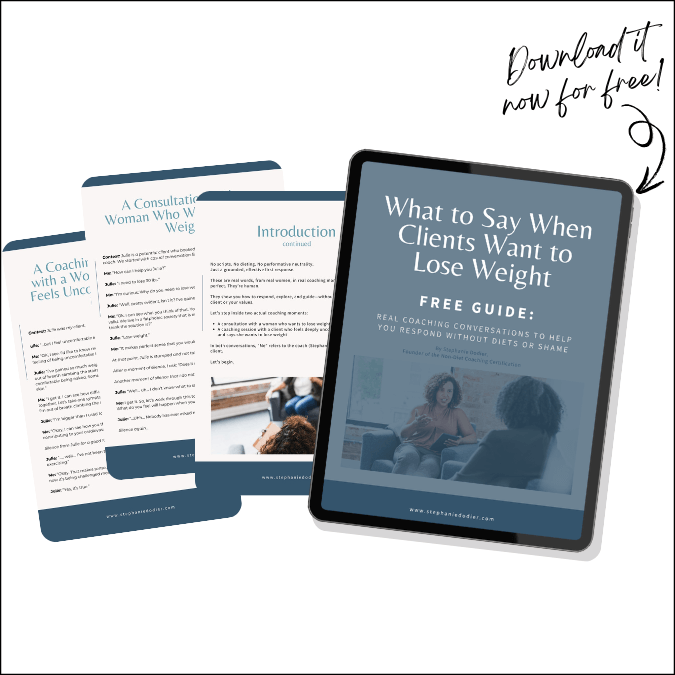
Non-Diet Coaching Certification
Work with me, including asynchronous 1:1 coaching
Full Episode Transcript
This transcript was auto-generated and lightly edited for clarity.
Click to expand the full transcript
How do you practice body acceptance after 50?
Body acceptance after 50 starts with recognizing that body image is broader than body size. Many women who have made peace with their weight are still caught off guard by signs of aging: a drooping neck, a face that looks like their mother’s, a photo from an unfamiliar angle. That reaction is not a failure of earlier work. It is a different belief system, internalized ageism, that most women have never examined.
The beliefs come from socialization. The thin ideal women are taught has always been young as well as thin. Men are often seen as gaining authority as they age, while older women are framed as irrelevant or invisible. The growing menopause and anti-aging market reinforces this by treating normal signs of aging as problems to fix, much like diet culture treats larger bodies.
A practical, evidence-informed approach uses cognitive behavioral self-coaching. Meet the reaction with self-compassion (“it makes total sense that I think this, given the culture I live in”). Write every thought down in a thought download, then question each one: is it a fact or a thought, and where did I learn it? Allow the emotion without forcing yourself back into situations that feel unsafe. Then choose a new, intentional thought ahead of time and practice it.
Body acceptance after 50 is not about loving every reflection. It is about having a reliable process for the moments when a reflection hits, because the body will keep changing. Non-diet nutritionist and cognitive behavior coach Stephanie Dodier teaches this process in the Body Acceptance Challenge and trains health professionals to use it with clients through the Non-Diet Coaching Certification.
Transcript
[00:00:08] Welcome to It’s Beyond the Food podcast, my sister. I’m your host, Stephanie Dodier, and today we’re gonna talk about body acceptance after 50
[00:00:18] And a teaser to this is I’m sharing a personal self-coaching experience where I got a haircut, and when the hairdresser spin the chair, I looked in the mirror and I saw my mother’s face. We’re gonna explore what is underneath that experience and why so many of us hit that phase where we, quote, “see our mother’s face looking at us” and the exact process that you should be using in order to help yourself in those moments.
[00:00:55] Now, I wanna acknowledge that this is my first solo episode in nearly two and a half months. For the last almost 10 weeks, I have been sharing interviews with some of my favorite colleagues and friends on topics that you, the listener, have been requested an area where I’m not an expert in. So I hope you enjoyed these interview.
[00:01:23] And now I’m starting again talking to you directly, and I wanna highlight something else. We’re coming up to the 500th episode of this podcast. I, I’m gonna keep talking about this because this is such a moment in my life as a person. It’s obviously a moment for me as a podcaster.
[00:01:52] It’s gonna be my 10th year of podcasting, the 10th year anniversary of this podcast in a 500 episode. It’s actually gonna be on November the 26th, the week of the American Thanksgiving. So I am building up to this, um, and I think, just a teaser, I think I’m gonna be starting a new series And this one’s gonna be very personal.
[00:02:22] Um, I’m gonna be sharing with you the journey of me, uh, something I started last week, me reading my journal from 12 years ago. So I have a, a drawer in my nightstand where every time I finish a journal where I practice thought work, where I practice powerful thinking, all the tools that I’m coaching my client with and teaching you here on the podcast, I have journals.
[00:02:54] And I’ve been stashing those journal in my nightstand drawer, and it was full. It was about two months ago. I could not cram the last one in, so I took them out. And right now they’re sitting on my living room table, and there’s over close to two dozen of them of journal dating back to 2013. I’ve started reading them, and it’s very emotional.
[00:03:27] So I think there’s some material there, uh, for me on the podcast of me reading it and sharing with you what I’m learning about myself through this. So if you think this is a great idea, I would love to hear from you either in the comment, in the YouTube video, or via Instagram. Come and find me and share with me what you think of that idea and what you would like to hear.
[00:03:51] But I wanna talk to you about my new haircut. So if you’re listening on audio right now, you’re probably not seeing my head, but if you’re watching on YouTube, I got a new pixie haircut. And this is not a first for me. I’ve had pixies at different stages of my life, but the latest one was before the pandemic.
[00:04:17] I had a pixie, and I had been having a pixie for about five years prior to that, and for reason I don’t remember, I decided to let it grow, and about a month ago, well, I would say five weeks ago, I got annoyed with the amount of time it took to care for my hair. My hair were about shoulder length, and it was taking too much time.
[00:04:45] So I decided to go to my hairdresser, show her a picture of me six years ago, and I said, “Let’s do this cut.” And she spin the, she always does that, she spin the chair around, and then she started cutting my hair so I didn’t look at me, myself, didn’t look at myself. And so at the end of the haircut, she’s, she does the reveal thing.
[00:05:09] And then she spin the chair around, and then I saw myself in the reflection in the mirror, and the first thought that went through my mind was, “Oh my God, you look like your mother. And you have your father’s neck.” And both of my parents are alive, so it was not reminiscence or grief. The feeling that went along with those thoughts were not that.
[00:05:36] My mom is 82, and I felt dissatisfied with my body. Just have to say it. I felt dissatisfied. And, and the face that I was seeing was completely different from the face I’d given her a photo from. My face was droopier, my neck was droopier, and I just spiraled out. And for the first couple days, and, and if you follow me on Instagram, I was thinking it was the haircut.
[00:06:04] I didn’t like my haircut. Uh, but I got honest with myself, and I realized it wasn’t the haircut. She had done a great job with the haircut. It was me. It was my thoughts. It was my feeling of dissatisfaction, of shame, of disgust that I was feeling. And It was very surprising to me at first when I, like, I journal.
[00:06:33] I’ve got a stack of journal to prove that. This is a… Like, I, I think of thought work or journaling like going to the gym. That’s for me, like, I do what I preach. And so for me, I train my brain to think a very specific way. So, so think of going to the gym and doing your whatever, your cardio, then your strength training.
[00:06:57] Like, I’ve got a routine where I do thought downloads, and then I do intentional thinking so that my brain is in the shape that it needs to be in for me to think the thoughts that I wanna think so that I experience the life that I want to experience and do the things I wanna do, right? So, um, and I was taken aback, and I think that’s why it took me 48 hours to clock in that it wasn’t about the haircut.
[00:07:28] It was about aging. And it was about me having ageist thoughts in my brain that then looked at the reflection in the mirror and labeled it, judged the reflection, criticized the reflection, and with these thoughts came along the feeling of dissatisfaction and, um, shame that I was feeling. And I disappeared from social media for about two weeks.
[00:08:02] So if you’re someone who’s following me on social media, you may have noticed that I wasn’t there much, and if I was, I wasn’t on camera. Which by the way, usually I’m every day on camera. And I was on camera, I was, like, posting old stuff, and the behind-the-scene is that I was giving myself the space to do exactly what I teach you to do in the body acceptance challenge.
[00:08:29] So when I clocked in and realized that it wasn’t about the haircut, it was about my thoughts about my face, I pulled out my own challenge, my own body acceptance challenge, and I did exactly what I’m teaching you to do, and I went to work. And I’m gonna share with you what I did, but I could not not tell you why this matter right now.
[00:08:56] Because as you know, I have a feminist lens on how I see, What most people describe as body image or nutrition challenges. And I wanna highlight for all of you that are listening to this that are above 40, although I have 500 episode, nearly 500 episode of me talking about the thin ideal, being about the size of your body, but I wanna highlight also that the thin ideal for women is also young.
[00:09:29] Like, it’s one thing, yes, it is thin, but it’s also young. And parallel to this, we have something happening in the wellness industry. We have a segment of the wellness industry that is called the, quote, “meno-boom.” It’s a brand-new division of the wellness industry aimed at aging women, and it’s growing faster than any other segment of the wellness industry.
[00:10:06] The global menopause market is currently at $15 billion, and it’s plan to grow by eightfold by 2030 That’s crazy. Just like there is a trend in nutrition, everything has protein on it, right? Get more protein. I saw a, a drink the other day, I think it was a water, that claimed to have protein in it. Like, we have the, the protein washing in nutrition, we have the meno-washing in wellness product where every product is rebranded as some kind of menopause aid, and skincare and anti-aging for women is the number one product in that category.
[00:11:10] And I want you to think of that meno-washing, meno boom as diet culture 2.0, the cousin of the wellness industry, where it tells you that your body is wrong for showing signs of aging, and that it is abnormal for you to show those signs. And that here’s the product, here’s the detox that is going to help you avoid this terrible thing that’s happening to your body.
[00:11:48] Because- A woman aging is not perceived in the same way as a man aging. This is where we get into feminism and gender-based cultural difference. We, men who are aging, who are s- showing sign of aging, are actually considered to be wiser, to be… They’re given more power in the societal structure that we have, and women are completely served differently.
[00:12:25] A woman who’s aging is considered to be irrelevant, incapable, less intelligent, and doesn’t deserve the space. An aging woman is to be invisible because she’s not beautiful to look at. So not only do we have to control the size of our body, we have to control how it age. So it’s a 2X factor in my world, right?
[00:12:59] It’s the mental, emotional space, the resource appropriation, money, time to control the size, and then when you hit 40, 45, then you have to layer the aging. So you have to continue to do everything you were doing for, to control the size of your body, and now you gotta layer even more things and money to control your skincare, to control how your skin show up, your hair, your adapted nutrition plan, and then your new fitness routine to control bone health and to control mobility so your body doesn’t show signs of age.
[00:13:44] It’s a never-ending story. And we need to have this conversation because it is most likely that- A large number of you are being exposed to podcast content, YouTube content that tell you that there is a thing called anti-aging. And for some of you, you may not have yet understood the, I call it the game behind it, which is the exact same thing as the weight loss industry and diet culture where we platform thinner body.
[00:14:21] Well, in this diet culture 2.0, we platform younger body, and we need to have this conversation. And this is what was happening in my brain. This is how powerful socialization is. Like, you take my brain, who goes to the gym every day, my brain with thought work, and has trained specifically in the context of body image and nutrition and health and business to have, like, very intentional thinking.
[00:14:57] But yet, in the back file of my brain where the belief system around aging are currently being held, unbeknownst to me, there were still some files in there that told me that at 51, having a drooping neck was wrong, and at 51, having drooping eyes is terrible, and that looking like an 80-year-old woman is terrible, like terrible things are gonna happen to you.
[00:15:30] And these are the thoughts that led me to have this look at my reflection in the mirror. So I used the Body Acceptance Challenge, and I went to work, and the first thing we do is, in the Body Acceptance Challenge, is we learn to have a relationship to ourselves, to our thoughts One of curiosity and one of self-compassion.
[00:16:03] So that’s what I did. When I clocked in after two days that this was happening and I took my journal to start doing some thought work, the first thing I did is say something like this to me, and I’m gonna give you the script, right? “It makes total sense for you, Stephanie, to have these critical thoughts towards aging signs that you are seeing in your reflection, ’cause you live in a society that demonize aging women.
[00:16:32] We live in a… You live in a society that’s ageist, and you have not yet done the work to, like, clean up these old files in your brain, so it makes total sense that would be your reaction seeing a different version of yourself in the mirror.” And then I went to actually doing what we call a thought download.
[00:16:55] When people come into my world, they think that because I’m constantly telling people, “You gotta write down your thought. You have to write down your thought,” and they think it’s kind of takes a lot of time, and could we skip that? And the answer is always no.
[00:17:13] Doing a thought download is a very, what I like to call, a surgical procedure where all these thoughts that are swirling in your brain, when you catch yourself being in an overthinking spiral, the reason why you keep spinning on the same thoughts is because you never take it out of your brain. And you never take it out, put it on a piece of paper, look at it, and debate with it.
[00:17:45] That’s what the thought download is about. So I did a thought download, and I, I, I had 32 thoughts within five minutes, and I really concentrated myself, 32 thoughts about my face, my neck, my age. Nothing about the size of my body, and that was, that was like a reminder of how powerful the work that I do can have on someone’s life.
[00:18:13] Not for one time in my 32 thoughts about my aging body was anything about the size. It was just about the aging piece of it And then I started to debate with the 32 thoughts. Like, is that a fact or is that a thought? And where did I learn to think this way? Which of those thoughts is a socialized thoughts?
[00:18:38] Which one is aligned with what I believe? ‘Cause that’s the key, right? When we extract those thoughts and put it on a piece of paper, in many cases it’s like, wow, I don’t believe that. Yet that thing was swirling in my brain for two days. And for some of you listening who have not done this thought work yet, you probably have a lot of thoughts that if you were to look at on a piece of paper, you’d say, “Huh, I don’t wanna think this.
[00:19:14] That’s bullshit. That’s not true.” That’s again, the power of thought work and thought download. So I looked at those thought, debated them, and then I sat with this. And this is why I want to talk about giving ourselves space. Some people think that, for an example, I, I was about two weeks not on social media.
[00:19:40] For many people, they think of this as hiding. For me, I think of it as giving myself space to feel my emotions, and that’s key, right? In, in a somatic approach to thought work, we want to Take action from a place of safety. So going back and, quote, “forcing myself” to be on social media, to be on camera when it felt very dissatisfying to me, that it felt like a trigger for shame would’ve been a really unsafe experience.
[00:20:21] So instead of pushing myself just to do the thing, I retreated, but I retreated in a very tactical place where I gave my myself the space to feel the emotion that came along with those thoughts, and then really anchor myself into a space of consent. That’s another big thing that I do in coaching is developing a relationship of self-consent, of acknowledging that here are the thoughts, here are the feelings, and here are the reason why you’re having this behavior.
[00:20:56] Do you wanna continue to behave this way? Because if you continue to think this way, you will continue to feel dissatisfied, and you will continue to want to avoid camera, which is not in alignment with your goal of being a digital coach who needs to be on camera for a living. So do you wanna change your thoughts?
[00:21:16] Do you wanna go through the process of changing your thoughts and taking uncomfortable action in order for you to feel comfortable in front of the camera? And that’s why I gave my- myself the space. I didn’t hide. I gave myself the space to make those decision and be really intentional of how I wanted to think about my body, about my aging
[00:21:45] And I wanna share with you the intentional thought that came out of that process, because that’s the third, um, step of the body acceptance challenge, is creating an intentional preemptive thought so that when you see your reflection in the mirror, the old thought will come up, right? You’re irrelevant, you’re being erased, you should be invisible, and then you have this new thought that you bring to your brain and say, “Okay, thank you for the old thought, brain, human brain, and then here’s a new way of thinking.”
[00:22:26] So we’re ready, right? And that’s the whole preemptive intentional thinking, is we’re ready with this new intentional way. So I wanna share it with you in case some of you need some inspiration. Um, my body is wise. My body has a living map of everything I survive, everything I loved, and everything I accomplish.
[00:22:53] I’m entering in a new era of my life where I am no longer seeking. End of quote So that’s my intentional way of thinking about my body and I practiced it, um, and I’m still practicing it every day. Uh, many of you are seeing me on Instagram story sharing mirror work that I do every day and that’s one of the thought that I practice.
[00:23:26] And then once that system was in place, that preemptive intentional system was in place and I knew what to think instead of the old thought, then I started to take action that are in alignment with that intentional thought. That’s when I started to come back on camera and started showing up on stories and now on the podcast recording a YouTube video in a place of safety.
[00:23:56] ‘Cause that’s probably one of the most frequent mistake that I see is people wanting to gaslight themselves in the process of changing their behavior and accepting their body by not first creating a safe environment for them to take those new actions
[00:24:17] So I’m happy to report three weeks later, here I am. I’m loving my haircut because I don’t have these thoughts when I look at myself, and I’m loving it because it’s saving me so much time. And that was, that was my intention in the first place of getting a pixie cut, to, like, be able to wash my hair and in five minutes of hair dry be done, which is exactly what it is now.
[00:24:44] Like, two minutes, two and a half minutes maybe of hair dry, some air wax, and then we’re done. I have so many other things to do than to do my hair in the morning. So it’s the same haircut The same haircut, the same look that sent me spiraling, let’s say four weeks ago, and that now I’m totally enjoying.
[00:25:12] Nothing has changed. I want you to s- stick with that, right? It’s… In the context of size, I always say it’s never about the layer of fat in your body, it’s about the thoughts you have about the layer of fat. Well, it’s the same thing with the haircut. It’s never about the haircut, it’s about the thoughts you have about the haircut.
[00:25:30] So I wanna invite you to consider, uh, learning this framework to approach changing bodies. And, and this is a second lesson here, is that your body will continue to change. Even though the work was done on the size perspective, for me, my body continued to change, and now it’s aging. And maybe in the future it’ll be disability.
[00:25:58] Like, I have chronic pain, I have a scoliosis. Maybe in 10 years from now I will lose mobility to a point where I won’t be able to travel, and I’ll have to do thought work again about this part of my body changing. And that’s the power of the Body Acceptance Challenge. It’s a framework, it’s a technique that you can apply as your body change and evolve.
[00:26:23] So I would invite you to come and do this challenge with me. Um, based on when you’re listening to this episode, we’ll do it live as groups, and I start a group almost every month. Um, if you’re listening live, the next group is starting on, uh, November the 13th. And if you’re listening at a time where it’s not November the 13th, just put your name on the wait list, and then you’ll be notified when the next cohort starts.
[00:26:52] And if you are a professional listening to this, because I got a large segment of listener that are professional, I just wanna highlight the importance of understanding intersectionality, understanding power system. Because for some professional out there, not understanding the ageism, the way capitalism work in regards to aging women and, and the thoughts we have, when your client bring these thoughts and these experience to you, unbeknown to you, you may be actually reinforcing some of these oppressive thoughts, right?
[00:27:38] When, when women say, like, “I have to color my hair,” and you may, you may just respond, “Yeah, it makes total sense. Makes total sense,” because maybe you’re coloring your hair and you’re thinking, “She doesn’t have a choice, that’s just what she has to do.” Right? So understanding the nature of power system- The nature of the identity and how society look at identity of a person is critical.
[00:28:06] And I wanna say if you’re a person, a woman going through this, it’s critically important in my eyes that the person you select to work with, be as a therapist, social worker, or coach, has a informed intersectional lens on whatever problems you’re trying to solve, or in my case, the feminist lens, right? In- so that we understand the power dynamic behind the problem, and that we’re actually not reinforcing the oppressive nature of our society, especially when it comes to size and age for women, but we are actually helping our client liberate themselves from those power systems so they actually can free themselves from all these containment of resource they have to spend in trying to erase who they are becoming and who they are, which is really what the weight loss industry and the anti-aging industry is.
[00:29:18] So if you are a professional and you wanna learn to do this work, consider the non-diet coaching certification. All right, my sister, it’s a pleasure to be back with you with a solo episode, and I will see you next week. And until then, I love you, and I’ll see you at podcast 498.
[00:29:39] If you are loving what you’re learning on the podcast, you have to come and check out two ways of continuing to work with me. The Body Acceptance Challenge is my four-week coaching container that will teach you how to change your thoughts about your body to feel confident in the body you have now and every version that come after it.
[00:30:02] After 10 years of clinical practice and over 1,000 women client, I know what to do, what to skip, and in what order for you to do it so you get to where you wanna be faster. Which leads me into the second container, which is a brand new way of working with me, asynchronous coaching. That is a private one-on-one coaching container where you have me in your back pocket.
[00:30:27] We’re connected together by voice and text, so I become your thought partner and the person you can lean on in the moment. You can find more detail at stephaniedodier.com/workwithme or with the link in the show note. I’ll see you there